
Retatrutide: qué es, cómo funciona y qué dice la investigación
Retatrutide es un compuesto en investigación desarrollado por Eli Lilly que actúa simultáneamente sobre los receptores GLP-1, GIP y glucagón. Actualmente se estudia por sus efectos sobre la regulación del apetito, el gasto energético, la composición corporal y la salud metabólica.
Retatrutide en Colombia
En Bogotá Peptides ofrecemos Retatrutide en Colombia con documentación y análisis de laboratorio específicos por lote. Contamos con envíos a nivel nacional y entregas rápidas en ciudades principales como Bogotá y Medellín.
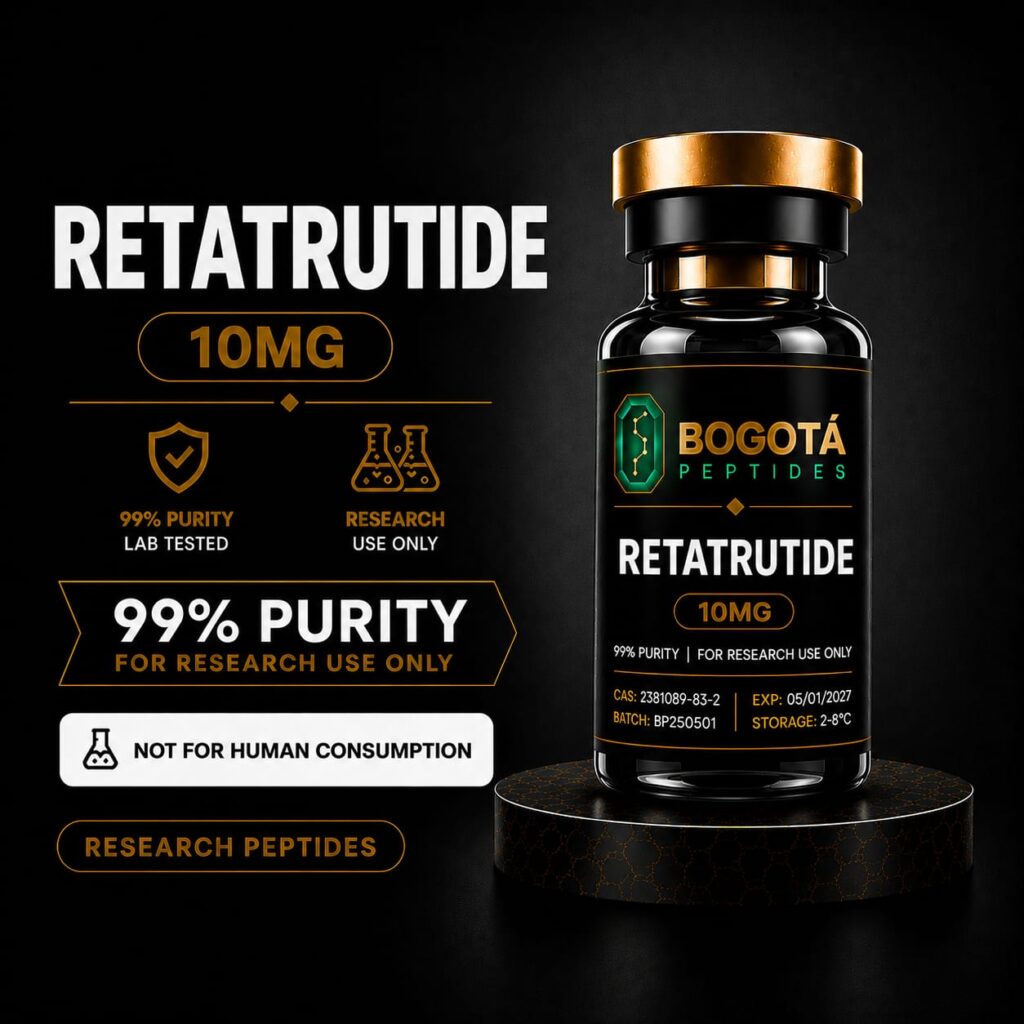
Retatrutide: una nueva generación en la investigación metabólica
Retatrutide (LY3437943) es un agonista triple de los receptores GLP-1, GIP y glucagón desarrollado por Eli Lilly. A diferencia de otros compuestos metabólicos que actúan sobre una o dos vías hormonales, Retatrutide combina la actividad de tres receptores en una sola molécula, un mecanismo que actualmente se estudia por su potencial en el tratamiento de la obesidad, el control del peso y otras condiciones metabólicas.
Semaglutide actúa principalmente sobre el receptor GLP-1, mientras que Tirzepatide combina la actividad de los receptores GIP y GLP-1. Retatrutide añade una tercera vía mediante la activación del receptor de glucagón, por lo que se conoce como un agonista triple GIP/GLP-1/glucagón. Esta combinación es una de las principales características que diferencia a Retatrutide de otros tratamientos metabólicos investigados hasta ahora.
La investigación clínica sobre Retatrutide ha avanzado desde los estudios de fase 2 publicados en 2023 hasta múltiples estudios de fase 3 del programa TRIUMPH. En TRIUMPH-1, Lilly informó una reducción media del peso corporal de hasta un 28,3 % a las 80 semanas en participantes que recibieron 12 mg, mientras que los resultados posteriores de TRIUMPH-2 y TRIUMPH-3 ampliaron la investigación a personas con diabetes tipo 2 y enfermedad cardiovascular. Retatrutide continúa siendo un medicamento en investigación y todavía no está aprobado para uso público.
¿Cómo funciona Retatrutide? GLP-1, GIP y glucagón
Retatrutide se diferencia por actuar simultáneamente sobre tres receptores metabólicos: GLP-1, GIP y glucagón (GCGR). Cada receptor cumple una función diferente relacionada con el apetito, el metabolismo y el equilibrio energético. Esta acción triple es la principal característica que distingue a Retatrutide de agonistas como Semaglutide y Tirzepatide.
Receptor GLP-1
La activación del receptor GLP-1 está relacionada con la regulación del apetito, el vaciamiento gástrico y la secreción de insulina dependiente de glucosa. Este receptor también forma parte del mecanismo de Semaglutide y Tirzepatide y es una de las principales vías estudiadas para el control del peso y la salud metabólica.
Receptor GIP
> Retatrutide también activa el receptor GIP, una vía que comparte con Tirzepatide. El GIP participa en la respuesta de insulina dependiente de glucosa y en diferentes procesos relacionados con el metabolismo y el equilibrio energético.
Receptor de glucagón (GCGR
La activación del receptor de glucagón es la tercera vía del mecanismo de Retatrutide y una de sus principales diferencias frente a Semaglutide y Tirzepatide. Esta vía se investiga por su relación con el gasto energético y el metabolismo, completando el perfil de Retatrutide como agonista triple GLP-1/GIP/glucagón.
¿Qué diferencia a Retatrutide de otros agonistas GLP-1?
La principal diferencia de Retatrutide es su mecanismo de acción triple. Mientras que Semaglutide actúa principalmente sobre el receptor GLP-1 y Tirzepatide combina los receptores GIP y GLP-1, Retatrutide incorpora una tercera vía mediante la activación del receptor de glucagón (GCGR).
Esta combinación de GLP-1, GIP y glucagón es lo que distingue a Retatrutide de los agonistas simples y duales. La activación conjunta de estos tres receptores se investiga por sus efectos sobre el apetito, el metabolismo, el gasto energético y la composición corporal.
> Este mecanismo ha convertido a Retatrutide en uno de los compuestos metabólicos más estudiados actualmente, especialmente dentro de la investigación sobre obesidad, pérdida de peso y diabetes tipo 2.
Estudios clínicos de Retatrutide: resultados de fase 2 y fase 3
Retatrutide ha sido evaluado en estudios clínicos aleatorizados y controlados en personas con obesidad y otras condiciones metabólicas. Los estudios de fase 2 mostraron reducciones significativas del peso corporal y dieron paso al programa de ensayos clínicos de fase 3 TRIUMPH.
Resultados de fase 2 • 12 mg • 48 semanas
En el estudio clínico de fase 2 publicado en The New England Journal of Medicine en 2023, Retatrutide alcanzó una reducción media del peso corporal del 24,2 % a las 48 semanas con la dosis de 12 mg.
| Dosis | Reducción media de peso | ≥5% de reducción | ≥15% de reducción | ≥25% de reducción |
|---|---|---|---|---|
| Placebo | -2,1% | 27% | 2% | 0% |
| 1 mg | -7,2% | 63% | 12% | 0% |
| 4 mg | -12,9% | 88% | 38% | 9% |
| 8 mg | -17,3% | 93% | 63% | 24% |
| 12 mg | -24,2% | 100% | 83% | 48% |
Retatrutide vs Tirzepatide vs Semaglutide: principales diferencias
Retatrutide, Tirzepatide y Semaglutide pertenecen a diferentes generaciones de agonistas de receptores metabólicos. Semaglutide actúa sobre GLP-1, Tirzepatide combina GIP y GLP-1, mientras que Retatrutide incorpora una tercera vía mediante la activación de GIP, GLP-1 y glucagón (GCGR). Estas diferencias en su mecanismo de acción han sido estudiadas en ensayos clínicos relacionados con obesidad, pérdida de peso y salud metabólica.
Semaglutide
GLP-1
Tirzepatide
GLP-1 + GIP
Retatrutide
GLP-1 + GIP + GCGR
Estudios y publicaciones científicas sobre Retatrutide
Retatrutide se ha convertido en uno de los compuestos más estudiados dentro de la investigación metabólica. Las siguientes publicaciones y estudios clínicos documentan su desarrollo, mecanismo de acción y resultados en áreas como obesidad, pérdida de peso, diabetes tipo 2 y salud metabólica.
Estudio de fase 2 de Retatrutide en obesidad
Triple-Hormone-Receptor Agonist Retatrutide for Obesity — A Phase 2 Trial
Publicado en The New England Journal of Medicine en 2023, este ensayo clínico de fase 2 evaluó Retatrutide en adultos con obesidad o sobrepeso y mostró reducciones significativas del peso corporal durante 48 semanas.
Retatrutide y enfermedad hepática metabólica (MASLD)
Retatrutide for Metabolic Dysfunction-Associated Steatotic Liver Disease
Este subestudio evaluó los efectos de Retatrutide sobre la grasa hepática y diferentes parámetros metabólicos, ampliando la investigación del compuesto más allá de la reducción del peso corporal.
Investigación farmacológica de fase 1
First-in-Human Evaluation of LY3437943
Los primeros estudios en humanos evaluaron la farmacología y el perfil de Retatrutide (LY3437943), incluyendo su mecanismo de acción como agonista triple de los receptores GIP, GLP-1 y glucagón.
Retatrutide y diabetes tipo 2
Los estudios clínicos han evaluado Retatrutide en personas con diabetes tipo 2, analizando sus efectos sobre el control glucémico, el peso corporal y diferentes parámetros metabólicos.
Programa de fase 3 TRIUMPH
El programa clínico TRIUMPH evalúa Retatrutide en múltiples estudios de fase 3 relacionados con obesidad, sobrepeso y otras condiciones metabólicas. En 2026 se publicaron nuevos resultados de fase 3, ampliando la evidencia clínica disponible sobre Retatrutide.
¿Qué es Retatrutide?
Retatrutide (LY3437943) es un compuesto en investigación desarrollado por Eli Lilly. Actúa simultáneamente sobre tres receptores metabólicos: GIP, GLP-1 y glucagón, por lo que se conoce como un agonista triple.
¿Cómo funciona Retatrutide?
Retatrutide activa los receptores GIP, GLP-1 y glucagón (GCGR). Estas vías participan en procesos relacionados con el apetito, el metabolismo, la regulación de la glucosa y el gasto energético.
¿Cuál es la diferencia entre Retatrutide y Tirzepatide?
Tirzepatide actúa sobre dos receptores, GIP y GLP-1, mientras que Retatrutide añade la activación del receptor de glucagón, creando un mecanismo triple. Además, actualmente existe un estudio de fase 3, TRIUMPH-5, que compara directamente Retatrutide con Tirzepatide.
¿Cuál es la diferencia entre Retatrutide y Semaglutide?
Semaglutide actúa principalmente como agonista del receptor GLP-1. Retatrutide combina la actividad de GIP, GLP-1 y glucagón, por lo que su mecanismo de acción es diferente.
¿Qué mostraron los estudios de fase 3 de Retatrutide?
En TRIUMPH-1, los participantes que recibieron 12 mg alcanzaron una reducción media del peso corporal de 28,3 % a las 80 semanas. En 2026 también se anunciaron resultados positivos de otros estudios de fase 3, incluidos TRIUMPH-2 y TRIUMPH-3.
¿Qué es el programa TRIUMPH?
TRIUMPH es el programa de desarrollo clínico de fase 3 de Retatrutide. Incluye estudios sobre obesidad y diferentes condiciones relacionadas, además de investigaciones sobre resultados cardiovasculares y renales.
¿Retatrutide está aprobado actualmente?
No. Retatrutide continúa siendo un medicamento en investigación y no está aprobado actualmente por ninguna autoridad regulatoria. Su seguridad y eficacia continúan siendo evaluadas en ensayos clínicos.
¿Quién desarrolla Retatrutide?
Retatrutide, también identificado como LY3437943, está siendo desarrollado por Eli Lilly and Company dentro de su programa de investigación cardiometabólica.
Lorem fistrum por la gloria de mi madre esse jarl aliqua llevame al sircoo. De la pradera ullamco qué dise usteer está la cosa muy malar.